
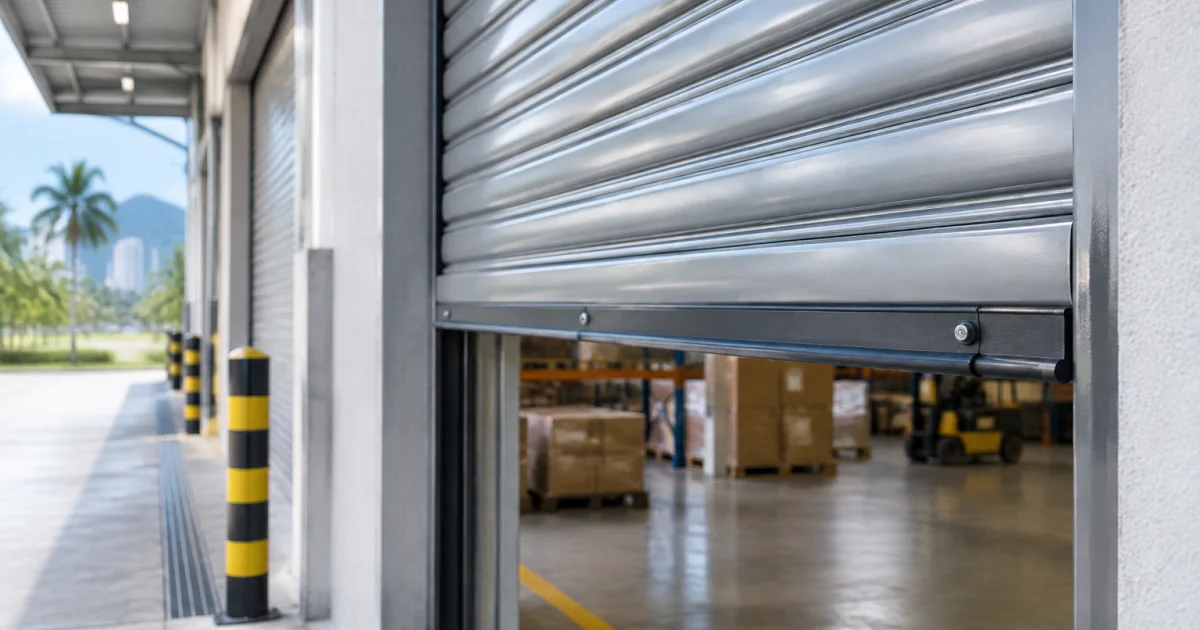
Industrial facilities rarely have “one-size-fits-all” access points. A back-of-house receiving entrance in a hypermarket has different needs from a production bay in a factory, and both differ again from a cold room or a clean zone. Understanding the basics of a Roll Up Door—how it’s built, what it’s made from, and which type fits your operation—helps reduce downtime, bottlenecks, and avoidable maintenance.
This beginner guide explains the main roll-up door categories (including high-speed options), common materials, and practical use cases for industrial sites in Malaysia. You’ll also see when an Overhead Sectional Door may be the better choice.
What is a roll-up door (and what problems does it solve)?
A roll-up door is a door system where the door curtain travels vertically and coils above the opening. Depending on the design, the curtain may be interlocking metal slats, a flexible PVC curtain, or insulated panels engineered to wrap around a barrel.
Roll-up systems are often chosen when you need:
- Fast, repeatable access for forklifts, pallet jacks, trolleys, and staff
- Space efficiency with a compact vertical opening path
- Separation between zones for dust, hygiene, temperature, or noise control
- Security at service entrances and storage rooms
- High-cycle reliability in busy areas with many daily door cycles
The right door is the one that matches your traffic pattern, environment, and risk level—not simply the most heavy-duty-looking option.
Main roll-up door types used in industrial sites
“Roll-up door” covers several designs. Below are common types used in warehouses, factories, retail back rooms, and controlled environments.
1) Rolling steel / rolling shutter doors (slatted metal)
These are the classic security-oriented doors made from interlocking steel or aluminium slats that coil overhead.
Best for: perimeter openings, service entrances, and storage areas that need a robust barrier after hours.
Things to watch: they can be slower and louder than purpose-built high-speed systems if not properly specified and maintained. If the opening is used continuously, a faster traffic door may reduce waiting and congestion.
2) High-speed roll-up doors (flexible curtain)
High-speed roll-up doors are engineered for frequent cycling and rapid opening/closing. They typically use a reinforced flexible curtain and controls designed for speed and safety.
Best for: internal logistics lanes, production-to-warehouse transfer points, retail receiving corridors, and openings where time and air exchange matter.
Why they’re popular: faster cycles can reduce airflow and temperature loss, support cleanliness, and keep traffic moving while reducing the time the doorway is open. For teams researching high speed doors supply and installation, match speed, activation method, and safety controls to real traffic conditions—not just brochure specifications.
For a reference point, IGT Group’s Easyrapid Roll Up Door is designed for high-traffic industrial applications where fast operation and separation are priorities.
3) Insulated roll-up doors (thermal performance focused)
Some roll-up designs focus on insulation and improved sealing to reduce heat transfer. This can be relevant in air-conditioned production areas, temperature-controlled storage, or sites aiming to reduce energy loss at frequently used openings.
Best for: temperature-sensitive zones that still require a roll-up mechanism (suitability depends on opening size and temperature requirements).
Things to watch: insulation and high speed can be a trade-off. In many facilities, zoning strategies (e.g., antechambers) paired with a fast door can outperform a single “do-everything” door.
4) Counter doors / compact service roll-ups
Smaller roll-up doors are used for counters, kiosks, storeroom hatches, or service windows. They’re compact but not intended for industrial vehicle traffic.
Best for: small openings and controlled access points in retail back-of-house areas.
Materials explained: how to choose what the door curtain is made of
Material affects durability, corrosion resistance, hygiene, visibility, and how the door behaves during impacts. Common options include:
Steel slats
Strength and security are the main advantages, making steel common for perimeter and storage access.
Considerations: in corrosive environments (e.g., coastal sites or certain industrial processes), specify protective coatings and plan maintenance to reduce rust and wear.
Aluminium slats
Aluminium is generally lighter than steel, which can help where frequent operation is needed but a rigid slatted curtain is still preferred.
Considerations: aluminium may dent more easily in some impacts; specify thickness and design based on real forklift routes and incident risk.
Flexible PVC / reinforced curtain materials
High-speed doors commonly use reinforced flexible curtains designed for smooth, high-cycle operation and operational separation (airflow, dust, insects) rather than after-hours security.
Considerations: choose appropriate thickness and reinforcement, and confirm safety devices and controls suit your risk profile—especially where pedestrians and forklifts share routes.
Insulated panels or foam-filled slats (where applicable)
Insulated constructions reduce heat transfer, supporting air-conditioned production areas and cold chain efficiency.
Considerations: sealing details (side guides, bottom edge, hood/box design) often matter as much as insulation claims. Good installation and fit can outperform a “better” door installed poorly.
Best use cases by facility: factories and hypermarkets
Use the scenarios below to match door families to common needs in manufacturing and retail environments.
Manufacturing factories
- Production-to-warehouse openings: High-speed roll-up doors support continuous transfer while reducing dust migration and airflow between zones.
- Quality-sensitive or cleaner areas: Consider fast-acting doors with reliable sealing, clear visibility, and access controls; reduce unnecessary cycles with defined pedestrian routes.
- Tool rooms and storerooms (security): A steel rolling shutter suits asset protection when speed is not the priority.
- Loading bay approaches: Evaluate the full loading-bay system (dock levellers, shelters, and protection) alongside the door, since door performance is only one part of safe, efficient loading.
Retailers & hypermarkets (back-of-house and receiving)
- Receiving bays and replenishment corridors: High-speed doors reduce waiting time during deliveries and help keep staff routes clear.
- Chiller/freezer transitions: Fast-closing doors reduce temperature loss during frequent cage movement.
- Waste handling and service entrances: Slatted doors provide more secure closure after hours, especially at external openings.
Many sites use a combination: a secure external shutter for perimeter protection and an internal high-speed door to maintain separation during operating hours.
Roll-up vs Overhead Sectional Door: how to decide
Roll-up solutions and an Overhead Sectional Door can both control access and improve security, but they behave differently in real operations.
| Decision factor | Roll-up door (typical) | Overhead sectional door (typical) |
|---|---|---|
| Headroom and space | Coils above opening; compact footprint | Panels run on tracks under the ceiling; needs clear track path |
| Speed options | High-speed models available for frequent cycles | Often moderate speed; depends on motor and specification |
| Insulation potential | Varies; sealing depends on guides and design | Strong options with insulated panels and perimeter seals |
| Security | Excellent with steel shutters; high-speed curtains focus on separation | Good security when specified correctly |
| Maintenance profile | Varies by type; high-speed doors rely on controls/sensors | Tracks, rollers, springs/hardware require scheduled servicing |
If your priority is fast cycling for traffic flow, a high-speed roll-up door is often the first option to explore. If you need insulation and a solid panel door for a larger external opening, a sectional door can be a strong contender.
For a sectional example, review IGT Group’s Easylift Overhead Sectional Door and compare its panel construction and usage scenarios against a roll-up alternative.
Specification checklist: what to ask before you buy
A door becomes a critical asset once it operates around forklifts, shift changes, cleaning routines, and delivery peaks. Use this checklist to guide vendor discussions and avoid under- or over-specifying.
1) Traffic pattern and opening frequency
- Estimated cycles per day during normal operations
- Mixed traffic (pedestrians + forklifts) or vehicle-only
- Need for rapid closing to protect temperature or hygiene
2) Opening size and available headroom/side room
- Exact clear opening width and height
- Headroom for coil/hood or tracks
- Side room for guides, controls, and protection barriers
3) Environment: temperature, moisture, dust, and cleaning
- Air-conditioned, hot loading bay, chilled, or washdown environment
- Cleaning frequency and chemical exposure (if any)
- Corrosion-resistant component requirements
4) Safety features and visibility
- Photo sensors, safety edges, warning lights/alarms where needed
- Vision panels or clear sections to reduce collisions
- Controls that fit operations (push button, pull cord, radar, access control)
5) Integration with other access solutions
Depending on your site, door performance may depend on supporting systems, such as:
- Loading bay equipment to improve transfer safety and efficiency
- Impact protection at jambs and guides to reduce damage incidents
- Traffic doors or PVC barriers for pedestrian routes and secondary separation
When the goal is quick internal separation rather than a motorised cycle, a PVC traffic solution may be more practical for some openings. IGT Group supplies options such as the Clearway Pvc Swing Door for visible, durable access between work areas.
6) Maintenance planning
Industrial doors are moving equipment. Confirm preventive maintenance schedules, spare parts availability, and typical wear items. Planned servicing helps reduce unplanned downtime, especially for high-cycle entrances.
Conclusion: pick the door that matches how your site actually moves
Choosing a roll-up solution is about matching door design to daily operations: how people and vehicles move, what you need to keep in (cold air, clean air) or keep out (dust, insects), and how critical each opening is to throughput.
Define the role of each opening—security, separation, speed, insulation—then shortlist the right door family (slatted shutter, high-speed curtain, insulated roll-up, or a sectional alternative). Validate the specification with accurate measurements and a maintenance plan. When the door fits the workflow, you get smoother logistics, safer traffic, and fewer disruptions.
If you’re comparing high-speed options for busy industrial sites, explore IGT Group’s related guide on High Speed Door Malaysia for additional context on applications and selection considerations.
Frequently Asked Questions
How do I choose between a roll-up door and an overhead sectional door?
Choose based on how the opening is used. Roll-up designs are often preferred when you need compact headroom use and frequent cycling (especially high-speed models). An Overhead Sectional Door is often a strong option for larger external openings where a solid, insulated panel door and perimeter sealing are priorities. The best choice depends on traffic frequency, available ceiling space, and whether you prioritise speed, insulation, or security.
What’s the difference between a rolling shutter and a high-speed roll-up door?
A rolling shutter typically uses interlocking metal slats and is commonly chosen for security and external access control. A high-speed roll-up door usually uses a flexible reinforced curtain and a control system designed for rapid opening and closing, making it more suitable for high-traffic internal routes, production-to-warehouse transfer points, and areas where reducing air exchange matters.
Which roll-up door type is best for factories with forklifts and pedestrian traffic?
For mixed traffic, look for a door designed for frequent cycles with strong safety features such as sensors and safety edges, plus good visibility to reduce collisions. In many factories, a high-speed door is used on the main logistics lane, while pedestrian routes may be better served with dedicated walkways and traffic doors or PVC barriers to reduce unnecessary door cycles.
Do you provide high speed doors supply and installation in Malaysia?
Yes. IGT Group provides industrial door solutions including supply, consultation, installation, and after-sales support for high-speed door applications. The right specification depends on your opening size, cycle rate, environment (dust, temperature, washdown), and required safety controls.
How often should industrial roll-up doors be serviced?
Service frequency depends on usage intensity and environment. High-cycle doors and doors exposed to dust, moisture, or impact risk generally need more frequent preventive maintenance. A practical approach is to set a scheduled inspection plan covering safety devices, guides/tracks, drive components, fasteners, and wear parts, then adjust based on operating conditions and any recurring issues.
Need help selecting the right industrial door for your site?
IGT Group helps factories, warehouses, and retail back-of-house teams choose door systems that match real traffic flow—then supports you with consultation, installation, maintenance, and repairs. If you’re deciding between a high-speed roll-up door, a sectional solution, or complementary access options like PVC traffic doors, we can recommend a practical configuration for your opening and operating conditions.