
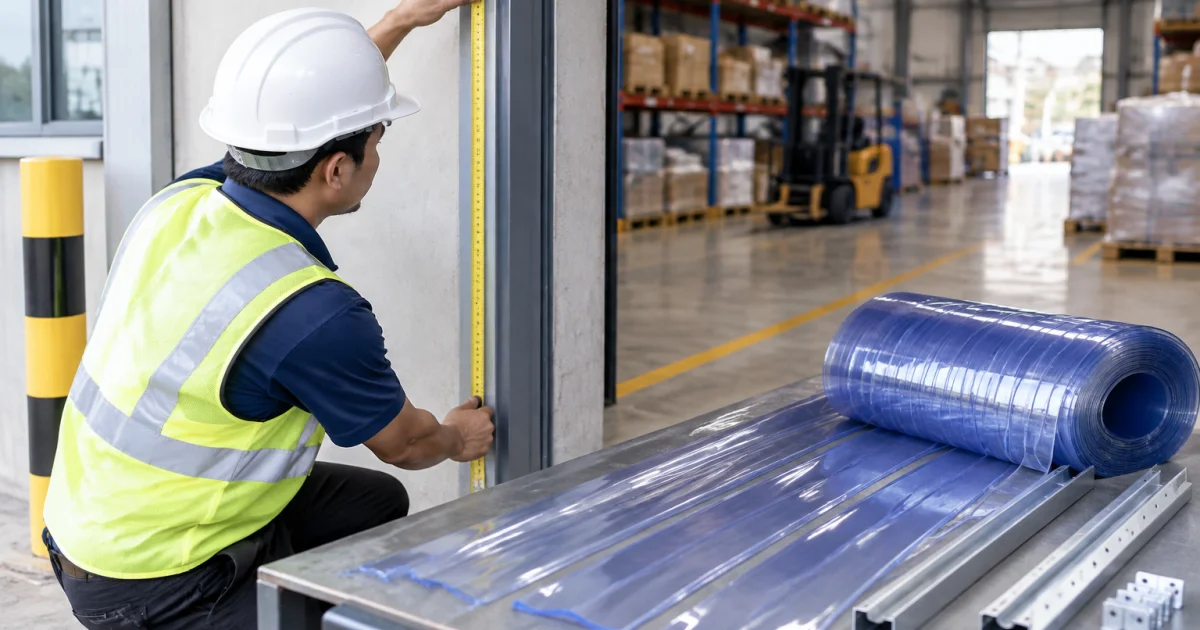
PVC strip curtains are a fast, cost-effective way to separate zones in warehouses and food processing plants without slowing pedestrians or forklifts. The results you want—temperature control, dust reduction, insect deterrence, and smoother workflow—depend on three things: accurate measurement, correct specification, and a clean, square installation.
This field-ready tutorial explains how to measure real warehouse openings, choose strip width/thickness and overlap for your traffic, select mounting hardware, and install and fine-tune the curtain. If you’re sourcing PVC Curtain Malaysia solutions for an active facility, these steps help you request the right configuration and avoid gaps, dragging strips, and premature wear.
Strip curtains also interact with door tracks, pallet flow, hygiene controls, and systems like high-speed doors, sectional doors, or PVC swing doors. The aim is separation that supports operations, not friction.
1) Confirm your use case (before you measure)
Define what the curtain must achieve and what will pass through it. This drives strip thickness, overlap, mounting height, and rail choice.
Identify the traffic type
- Pedestrian-only: staff walking, hand trolleys, carts.
- Light vehicle traffic: pallet jacks, small stackers.
- Forklift traffic: counterbalance or reach trucks, frequent passes.
- Mixed traffic: pedestrians plus forklifts (common at dispatch/receiving).
Heavier/faster traffic typically needs thicker strips and a hanging system that makes single-strip replacement quick after impacts.
Define the environment you’re separating
- Ambient to ambient: dust control, insect deterrence, noise reduction.
- Chilled/cold room to ambient: reduce cold-air loss and unwanted air exchange.
- Food processing hygiene zones: reduce cross-contamination and manage splashes/airflow.
- Controlled production areas: limit particulate movement and drafts.
For temperature separation, you’ll usually specify higher overlap and keep strips close to the floor without creating a trip hazard or heavy drag.
Decide whether the curtain is standalone or paired with a door
Strip curtains may sit behind a primary door (for example, a high-speed roll-up door) to reduce air exchange when the main door cycles, or they may be the only barrier. Note headroom and side clearance, because they determine where the rail can be mounted.
2) Safety and tools checklist
Measuring and installation often happens at active doorways. Treat it like a small site job to avoid hazards and rework.
Tools you’ll likely need
- Tape measure (5–8 m for wider openings)
- Laser measure (optional)
- Spirit level
- Marker or chalk
- Step ladder or mobile platform
- Drill/driver and correct bits (steel, concrete, masonry)
- Fasteners/anchors suited to the substrate
- PPE: safety shoes, gloves, safety glasses, helmet (as required)
Operational safety planning
- Traffic control: isolate the doorway, schedule low-traffic periods, or use spotters.
- Working at height: use stable access equipment; avoid overreach when setting rails.
- Hygiene (food zones): keep tools clean and store strips off the floor.
Also protect the strips: dragging PVC over dirty floors or sharp edges can scratch it and reduce clarity.
3) How to measure a warehouse opening (step-by-step)
Measurement is more than width and height. You must confirm where the rail can be fixed, whether the opening is square, and whether anything will interfere with strip swing.
- Measure clear opening width (W): measure between side jambs at the top, middle, and bottom. Record the smallest value.
- Measure clear opening height (H): measure from floor to the underside of the lintel (or lowest obstruction) on left and right. Record the smallest value.
- Check the threshold/floor: look for ramps, drains, raised joints, or uneven edges that affect strip clearance and trolley movement.
- Confirm headroom for the rail: especially important for face mounting above the opening.
- Confirm side clearance: if you need extra cover beyond the opening width, ensure strips won’t foul on racking, bollards, or conduit.
- Measure the vehicle envelope: for forklifts, record typical load height and width so strips clear loads without ripping.
- Document obstructions: photograph items that can snag strips (tracks, protruding bolts, lock boxes, racking edges).
Practical tip: If forklifts often carry tall loads, avoid leaving a “header gap” above the strips. Gaps become leakage paths for air, dust, and insects.
Choosing the mounting position: soffit vs face
- Soffit mount (under-lintel): neat and minimizes projection into aisles; confirm there’s solid material for anchoring.
- Face mount (front of opening): helpful when the soffit is unsuitable or when you want extra side cover; may project slightly into the approach path.
If unsure, measure for both and share photos so your supplier can recommend the safer, more serviceable option.
4) How to specify PVC strip curtains (dimensions, overlap, and material)
Two curtains can look similar but perform very differently. Get strip size, thickness, overlap, and length aligned with traffic and environment.
Step 1: Choose strip width
Industrial strip widths vary from narrow pedestrian strips to wider vehicle strips. In general:
- Narrower strips reduce push force and can seal well due to more contact points.
- Wider strips suit larger openings and forklift lanes (fewer strips to manage) but can feel heavier to push through if thick.
For mixed pedestrian and trolley traffic, a mid-width strip with sensible overlap usually balances access and separation.
Step 2: Choose strip thickness
Thickness affects durability, hanging stability, and how well strips return closed after passage. Thicker strips typically:
- handle impact and tearing better in busy forklift lanes,
- flutter less when there are pressure differences or strong fans,
- require more force for pedestrians.
In food areas with frequent hand movement, you may prioritize easier push-through while maintaining adequate overlap.
Step 3: Set the overlap percentage
Overlap is how much each strip covers the next. More overlap improves sealing against air movement and dust but increases push-through resistance and adds layered visual distortion. Less overlap improves access but can create gaps.
Practical examples:
- Forklift lane (ambient-to-ambient): moderate-to-high overlap to reduce drafts and dust, especially near fans.
- Chilled room entrance: high overlap to reduce cold-air loss and condensation risk.
- Pedestrian hygiene partition: moderate overlap can be sufficient if strips are correctly sized and kept clean.
Don’t make your supplier guess—share traffic frequency, vehicle type, and the separation goal.
Step 4: Decide strip length (floor clearance)
Strips should hang close to the floor to limit leakage, but not so low they constantly drag or fold under wheels. Keep in mind:
- Forklift and pallet-jack wheels can catch overlong strips and tear them.
- Uneven floors cause some strips to scrape while others float, creating leaks.
- In wet zones, dragging strips can spread water or contaminants.
Measure floor variation across the opening and specify clearance that avoids constant scraping while still sealing effectively.
Step 5: Material and finish considerations
Clear PVC is common because it improves visibility and reduces collision risk. Tinted or ribbed strips may help with glare or privacy, but clarity is usually preferred in mixed traffic areas.
For cold rooms, confirm the PVC remains flexible at low temperatures. For food environments, ensure the curtain is suitable for hygienic use and compatible with your cleaning routine.
Step 6: Specify the mounting system
Most systems use a rail with hanging plates/clamps so individual strips can be removed and replaced. Confirm:
- Rail type: fixed or quick-release for faster maintenance.
- Corrosion resistance: important for washdown, humidity, or coastal sites.
- Fixing method: correct anchors for concrete or fasteners for steel frames.
- Serviceability: ability to replace a single damaged strip without dismantling the curtain.
5) Calculate strip quantity and layout (simple method)
Even if your supplier calculates it, understanding the logic helps you verify coverage.
Basic layout logic
To cover opening width W using strip width S and overlap O, each additional strip contributes less than S because part of it overlaps the previous strip. The key effects:
- More overlap = more strips needed for the same width.
- Wider strips = fewer strips (but potentially heavier to pass through).
Practical check: Request a layout drawing or strip-count calculation, and confirm whether the design includes extra side cover (often useful for face mount or uneven jambs).
Single vs double curtain (when to consider it)
For demanding temperature separation with frequent traffic, some sites use a double-layer setup (two rows of strips with an air gap). It can improve separation but increases resistance and maintenance, so it’s usually reserved for higher-performance needs.
6) Installation steps for PVC strip curtains (clean, square, serviceable)
Installation quality controls sealing and service life. The steps below assume a typical rail-and-strip system.
- Prepare the area: isolate the doorway, clean the mounting surface, and confirm all components are on hand.
- Mark the rail line: use a level to mark a straight reference line. An unlevel rail creates uneven strip lengths and floor gaps.
- Set alignment/coverage: center the rail so strips cover the opening evenly; for face mount, include the side cover you specified.
- Fix the rail securely: drill/anchor appropriately for the substrate; a loose rail causes shifting and becomes a safety risk.
- Hang strips consistently: work from one side across and maintain the designed overlap throughout.
- Verify floor clearance: strips should hang straight and close to the floor without heavy drag. Only trim if the product/system allows safe trimming without compromising the hang point.
- Test real traffic: walk through, then try a trolley/pallet jack, then a forklift at low speed. Check for snag points and excessive resistance.
- Fine-tune: correct twists, adjust alignment, and ensure edges seal where needed (especially around uneven jambs).
Common installation mistakes to avoid
- Mounting too high and leaving a floor gap that leaks air/dust.
- Under-anchoring the rail into weak material.
- Uneven overlap that creates weak sealing points.
- Ignoring obstructions that cut or scratch strips.
- Skipping traffic tests: issues appear immediately with wide pallets—test before fully reopening the lane.
Example: forklift opening at dispatch bay
Scenario: A dispatch bay is used by forklifts moving pallets every few minutes, with dust movement from fans and frequent temperature changes because the bay door cycles often.
Good specification and install choices:
- Durable strips plus a serviceable hanging system for quick strip replacement.
- Consistent overlap to reduce drafts while keeping push-through manageable.
- Face mount slightly wider than the clear opening if jambs are uneven or side gaps are common.
- Post-install test using a typical wide pallet to ensure strips don’t catch on corners.
7) Maintenance, cleaning, and replacement planning
PVC strip curtains are low-maintenance, but busy warehouses and hygiene zones still need routine checks to keep performance consistent.
Routine inspection checklist
- Check for tears and cracks at edges and hanging points.
- Check overlap: strips can shift if clamps loosen.
- Check rail tightness: vibration and impacts can loosen fixings.
- Re-check clearance if floor levels change (resurfacing, ramps, new thresholds).
Cleaning guidance (especially for food processing)
Use methods compatible with PVC and your site protocols:
- Clean regularly to maintain visibility and reduce contamination risk.
- Avoid abrasive tools that scratch and reduce clarity.
- Replace strips that become cloudy, heavily scratched, or hard to sanitize.
Practical tip: Keep spare strips on-site in the same type and size. One torn strip can create a gap that undermines the whole separation.
8) Choosing the right supplier and when to consider other industrial doors
Many buyers start with strip curtains, then discover they also need faster cycling, better security, or stronger insulation. A good supplier should help you choose the simplest system that meets your operational goals—sometimes strips alone, sometimes a combination.
What to ask a PVC curtain supplier
- Can you recommend strip size and overlap for my traffic type and environment?
- Which mounting system enables the fastest single-strip replacement?
- How should I measure non-square openings or openings with obstructions?
- Do you support installation and after-sales adjustments/repairs?
If you’re comparing PVC Curtain Supplier Malaysia options, prioritize suppliers who provide a clear specification with layout and hardware plan, not just a generic quote.
When a high-speed door or sectional door may be a better fit
- Very high cycle rates and you need rapid open/close to control air exchange: consider a high-speed roll-up door, optionally paired with strips as a secondary barrier.
- Security and weather protection at external openings: an overhead sectional door may be more suitable than strips alone.
- Pedestrian corridors and hygiene separation where you want a defined doorway feel: a PVC swing door can be a better match.
Many facilities use a mix: strip curtains for internal lanes, swing doors for pedestrian routes, and powered doors where speed, insulation, or security is critical.
Useful next reads
- Easyflex Pvc Curtain for product options and typical applications.
- Clearway Pvc Swing Door if you need a more defined traffic door between work zones.
- Our Products to compare industrial access solutions for different openings.
- Cold Chain Access Solutions Maintaining Temperature And Efficiency if your main goal is reducing cold-air loss.
Conclusion: measure carefully, specify clearly, install for real traffic
Getting PVC strip curtains right is about matching the curtain to your opening and operations. Define traffic and environment first. Measure the opening at multiple points, note mounting surfaces and obstructions, then specify strip width, thickness, overlap, and length based on what actually moves through the doorway. Install the rail level, keep overlap consistent, and test with real loads before returning the lane to full use.
For smoother procurement, prepare a simple measurement sheet (W, H, mounting method, traffic type, temperature/hygiene needs, plus photos). With that, a specialist can recommend a configuration that seals better, lasts longer, and stays easy to maintain when individual strips need replacement.
Frequently Asked Questions
Should I measure the opening width and height in multiple places?
Yes. Measure width at the top, middle, and bottom, and measure height on both left and right sides. Use the smallest measurement as your clear opening size, then plan any extra cover needed for face mounting or uneven jambs.
How much overlap do PVC strip curtains need for a warehouse forklift lane?
Forklift lanes usually benefit from moderate to high overlap to reduce drafts and dust movement, but the right amount depends on traffic frequency and how much push-through resistance you can tolerate. Provide your traffic details to your supplier so overlap can be specified for performance without slowing operations.
Can PVC strip curtains be used for cold rooms or chilled warehouse entrances?
Yes. Strip curtains are commonly used to reduce cold-air loss and unwanted air exchange at chilled and cold-room openings. For these entrances, specify suitable material for low temperatures and a higher overlap, and ensure the strips hang close to the floor without excessive dragging.
What’s the difference between PVC strip curtains and a PVC swing door?
Strip curtains create a flexible barrier across the whole opening and are ideal for frequent pass-through by people and vehicles. A PVC swing door provides a more defined doorway with swinging panels, often preferred for pedestrian corridors, hygiene separation, and controlled access where you want a clearer entry/exit point.
When should I consider a high-speed roll-up door instead of strip curtains?
Consider a high-speed roll-up door when you need rapid open/close cycles to control air exchange, improve workflow at very high traffic rates, or add a stronger primary barrier. Many facilities pair high-speed doors with strip curtains as a secondary layer for added separation.
Need help sizing and installing PVC strip curtains correctly?
IGT Group supplies industrial PVC strip curtain systems and can help you specify strip size, overlap, and mounting to match your warehouse or food processing traffic. If you share your opening measurements, photos, and usage details, our team can recommend a configuration that installs cleanly and stays easy to maintain.