
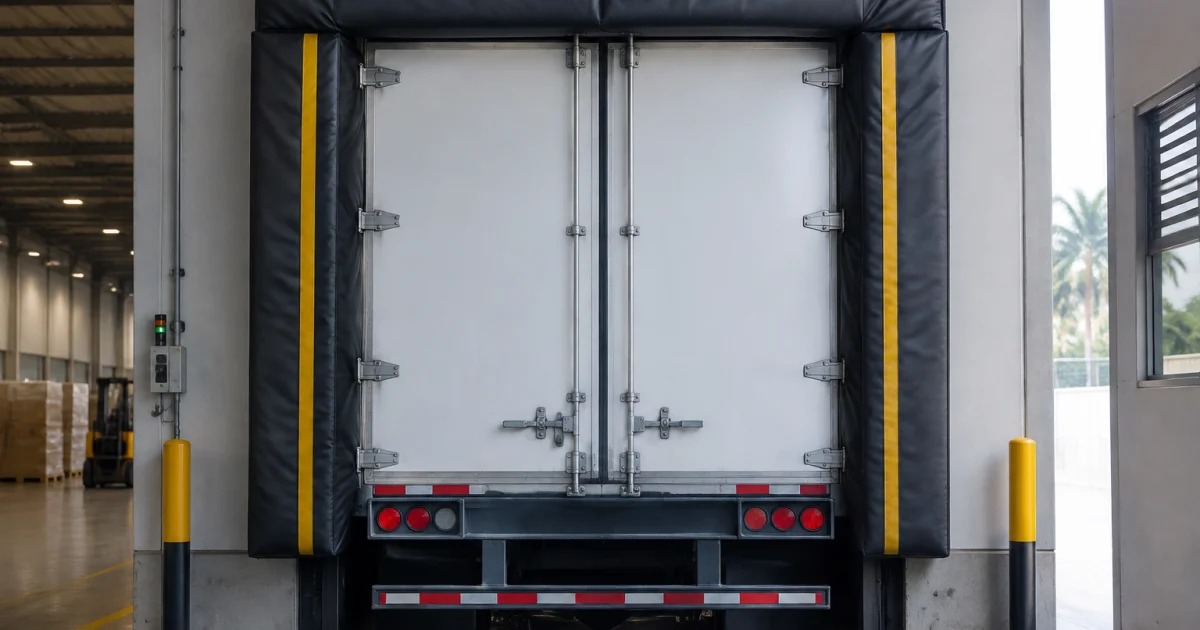
Busy warehouse and cold storage docks share a constant problem: every minute a bay stays open, indoor air is exchanged with outdoor air. That can drive temperature drift, condensation risk, dust and pest pressure, and uncomfortable working conditions at the dock face. It also affects throughput—teams work slower when conditions are wet, windy, or hard to align safely.
A well-specified Loading Dock Shelter is one of the most direct ways to reduce that exchange without changing your operation. Today’s dock shelters are no longer “pads on a frame”: newer designs aim to seal across trailer variability, survive repeated impacts, and reduce energy loss at the bay.
This article explains what’s changing, why it matters for warehouses & distribution centres and cold storage facilities in Malaysia, and how to evaluate shelter designs alongside related loading-bay equipment (including Hydraulic Dock Levelers) so the whole bay performs as a system.
Why dock shelter design is evolving: sealing, safety, and energy loss
Many older docks were built around predictable vehicle types and schedules. Today, facilities handle mixed fleets, third-party transport, faster turnarounds, and stricter hygiene expectations—especially in food and cold chain operations. These conditions expose common weaknesses:
- Inconsistent compression against uneven trailer surfaces (gaps at corners, top, or hinge lines).
- Premature wear from abrasion, UV, and heavy bay traffic.
- Air leakage paths around the shelter frame, dock door perimeter, and under-leveler voids.
- Damage and downtime when trailers back in off-centre or make hard contact.
Design updates focus on stronger construction, smarter sealing geometry, and options that suit ambient DC bays, chilled docks, and freezer-adjacent openings where moisture control is critical.
Better sealing: design changes that close the real-world gaps
Sealing performance is determined by what happens during a normal dock cycle: trailer approach, contact and compression, door opening, leveler deployment, loading, and departure. Newer approaches target “edge leakage”—small but persistent gaps that appear as trailers flex, settle, or park imperfectly.
More forgiving compression zones
Improved shelter faces use shapes and reinforcement that maintain contact when a trailer isn’t perfectly square. The goal is consistent sealing across more parking variability without excessive pressure that accelerates wear. Prioritise designs that:
- Hold a stable seal at top corners (common leakage points).
- Deflect in a controlled way under repeated rubbing rather than tearing.
- Recover shape after compression so the next vehicle still seals reliably.
Sealing continuity with the dock door and frame
A shelter can still leak if adjacent components aren’t coordinated. Air often moves through gaps around the dock door perimeter or behind the shelter frame. Treat the shelter as part of a dock opening assembly that includes the industrial door, frame condition, and installation detailing.
Where door upgrades are planned, an overhead system such as an Easylift Overhead Sectional Door can improve weather resistance and reduce perimeter gaps when closed while keeping headroom practical for busy bays.
Managing the under-leveler leakage path
In many facilities, the dock leveler area becomes a major pathway for unwanted air exchange—especially in cold chain operations. Coordination with Hydraulic Dock Levelers matters because predictable operation supports faster bay cycles and more consistent alignment, reducing door-open time and wear on contact surfaces.
If you are reviewing the bay as a system (shelter + door + leveler), the Easylift Dock Leveller overview can help align equipment selection and service planning.
Durability upgrades: materials and construction that survive high-traffic bays
Warehouse bays are harsh: UV, rain splash, wind-driven debris, exhaust, and constant abrasion degrade fabrics and fasteners, and minor trailer impacts are routine. Modern shelters respond with tougher construction and serviceable wear parts.
Stronger front faces and abrasion resistance
Contact surfaces are being made more abrasion-tolerant while staying flexible enough to seal. During evaluation, focus on practical lifecycle questions:
- Where will it wear first? Hinge lines and door hardware often scrape the same zones repeatedly.
- Can wear components be replaced? Modular pads/face elements can reduce lifecycle cost when only damaged parts are swapped.
- How easy is inspection? Clear sightlines help spot tears or loosening early.
Frames and fixings designed for impact and alignment
Durability depends on the frame and how it’s installed. Better designs aim to spread loads so repeated compression and minor impacts don’t pull the assembly out of square. Stable alignment improves sealing consistency and reduces unintended rubbing.
Traffic management also affects shelter life: wheel guides, clear markings, and bay protection reduce harsh contact. Rubber fenders can take the brunt of trailer contact and help protect both building and dock equipment (IGT Group supplies Easyguard Rubber Fenders).
Designing for maintainability (not just “strength”)
For MOFU buyers, performance after sustained use matters as much as day-one specifications. Service-friendly features—replaceable curtains, accessible fasteners, and designs that minimise dock shutdowns—often protect long-term sealing better than heavier assemblies that are difficult to maintain.
Energy control at the bay: what “better sealing” really delivers
Energy control is not only about utility cost. It impacts temperature stability, condensation management, and dock comfort. In cold storage, uncontrolled air exchange can cause fogging, slippery surfaces, and ice near the opening. In ambient distribution, it can create hot zones, humidity swings, and dust migration into the warehouse.
Reducing door-open time with faster, coordinated access systems
Even an excellent shelter can’t offset long open times. Energy performance improves when the bay cycle is efficient: correct docking, prompt door opening, smooth leveler deployment, loading, and closing without delay.
Facilities with frequent cycles often use faster-operating doors at the dock or as internal separation to limit how far dock-side air disturbance travels. Where it fits your layout, an Easyrapid Roll Up Door can help reduce unnecessary air movement without relying on staff behaviour.
Layered barriers for cold chain and hygiene-sensitive operations
Cold storage and food operations often benefit from layered control: an exterior dock shelter plus internal separation between staging and controlled rooms. For pedestrian and cart pathways near the dock staging area, a transparent impact door such as a Clearway Pvc Swing Door can reduce air mixing while maintaining visibility and safe movement.
Some sites also use flexible strip barriers in specific lanes. Selection should be driven by hygiene regimes, forklift speed, and temperature differentials—map where separation is truly needed and specify barriers accordingly.
Operational signals to look for: condensation and comfort
Instead of relying only on performance claims, assess bay control using real operational signals:
- Condensation on frames, leveler plates, or nearby floor zones.
- Drafts felt by dock staff during peak receiving hours.
- Dust trails or debris accumulation around the dock opening.
- Temperature drift near the staging area versus deeper warehouse zones.
These signs help pinpoint whether the limiting factor is shelter contact, door perimeter leakage, leveler behaviour, or operating practices that keep the opening exposed.
Specifying the right dock shelter: a practical checklist for buyers
To compare options and suppliers effectively (commercial investigation intent), turn “design updates” into specification questions during site walks and vendor discussions.
1) Your trailer profile and approach behaviour
- What trailer types and sizes dock most often?
- How often do you see off-centre parking or angled approaches?
- Do trailers have protruding hardware that scrapes shelter faces?
More variability typically means prioritising forgiving sealing geometry and impact-tolerant contact surfaces.
2) Temperature and hygiene requirements at the dock interface
- Is the staging area temperature-controlled, semi-controlled, or ambient?
- Do you have strict insect/dust control requirements?
- Are there washdown or hygiene routines that affect materials and fixings?
For cold storage and food operations, dock sealing supports both temperature control and contamination control—not just weather protection.
3) Integration with dock doors, levelers, and bay protection
- Is the dock door still fit for purpose, or leaking at the perimeter?
- Are your Hydraulic Dock Levelers operating smoothly and aligning consistently?
- Do you have adequate protection (fenders, guides) to reduce impacts?
Upgrading only the shelter while leaving door leakage, misalignment, or poor protection often limits achievable sealing and energy gains.
4) Maintenance plan and spare parts reality
- What inspections are recommended, and how long do they take?
- Which components are wear parts, and can they be replaced with minimal downtime?
- Is local technical support and genuine spare parts availability confirmed?
Preventive maintenance is often what separates “good on day one” from “good after 18 months.”
5) Supplier capability: design advice, installation quality, and service response
Dock sealing is sensitive to installation detail. Suppliers who assess dock geometry, vehicle patterns, and door/leveler interfaces typically deliver better outcomes than “swap like-for-like” replacements. Where downtime is costly, service response becomes part of the purchasing decision.
Conclusion: treat the dock as a system, not a single product
Loading bays are where environmental control meets real-world impacts and time pressure. Current shelter design updates focus on consistent sealing despite imperfect parking, better durability under abrasion and minor impacts, and improved energy control by reducing air exchange.
To capture the full benefit, specify your Loading Dock Shelter in context—together with the dock door, leveler, and bay protection. When these elements are selected and installed as a coordinated system, you reduce drafts and condensation risk, support hygiene outcomes, and keep receiving/shipping throughput predictable.
If you’re planning an upgrade, start with a site assessment of leakage points and dock-cycle behaviour, then shortlist solutions based on sealing geometry, maintainability, and service support—not appearance alone.
Useful next reads
- Easyshelter Dock Shelter
- Cold Chain Access Solutions Maintaining Temperature And Efficiency
- Our Products
Frequently Asked Questions
What is the difference between a dock shelter and a dock seal?
A dock shelter typically uses side and head curtains/pads to create a seal around a wider range of trailer sizes, while allowing more flexibility for different vehicle profiles. A dock seal generally compresses foam pads directly against the trailer for a tighter contact on more consistent trailer sizes. The better choice depends on your fleet mix, approach accuracy, and how much variability you see day to day.
How do I know if my loading bay is losing too much cold air or conditioned air?
Common operational signs include persistent drafts near the opening, condensation on the frame or leveler area, slippery floors near the dock, noticeable temperature drift in the staging zone, and dust/debris accumulation around the dock door perimeter. These indicators often point to gaps at the shelter contact points, door perimeter leakage, or an under-leveler air path.
Do Hydraulic Dock Levelers affect dock shelter sealing performance?
Yes. Dock shelter performance depends on a consistent dock cycle—stable trailer positioning, predictable door opening, and smooth leveler operation. When Hydraulic Dock Levelers are misaligned, slow, or unreliable, doors can stay open longer and the bay opening may not align consistently, which increases air exchange and can accelerate wear on seals and contact surfaces.
Can a high-speed door help with energy control at the loading bay?
Often, yes—especially when used as an internal separation between the dock staging area and temperature-controlled zones. A high-speed door reduces the time that openings remain exposed and helps limit how far dock-side air disturbance travels into the facility. It works best as part of a system with the dock shelter, dock door, and leveler coordinated for efficient bay cycles.
What maintenance should I plan for a dock shelter in a high-traffic warehouse?
Plan routine visual inspections for tears, abrasion, loose fixings, and frame alignment; cleaning to prevent grime buildup that can hide damage; and periodic checks after impacts. Ask your supplier which parts are considered wear items and whether they can be replaced without removing the full assembly. A preventive maintenance schedule helps keep sealing performance consistent and reduces unplanned downtime.
Plan a dock sealing upgrade with IGT Group
If you’re comparing options for better sealing, durability, and energy control at your bays, IGT Group can help you assess your dock opening as a complete system—dock shelter, dock doors, levelers, and protective accessories—then recommend a practical specification for your traffic and temperature needs.
From loading dock equipment and industrial doors to installation, maintenance, and repair support, our team focuses on solutions built for demanding warehouse, logistics, and cold chain environments.