
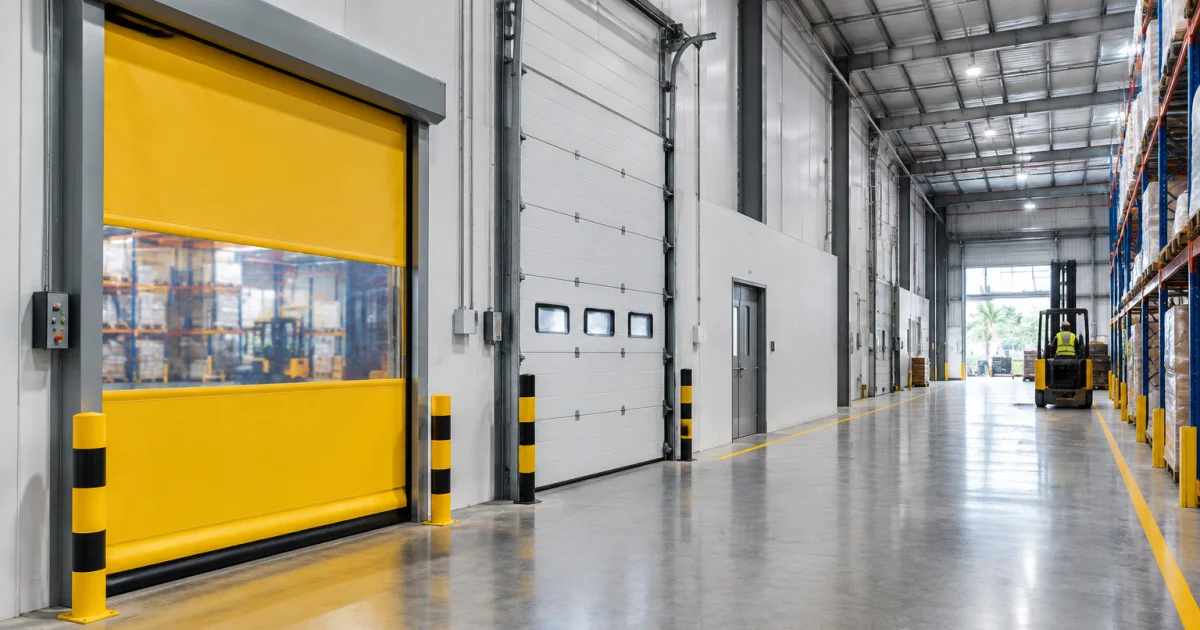
In an industrial facility, an opening is an interface between zones with different risk profiles, temperatures, cleanliness levels, pressures, and traffic. Specifying an Industrial Door Malaysia solution is best approached as a simple process: translate site conditions into performance requirements, then choose the simplest door type that meets them reliably.
This guide helps specifiers, plant engineers, warehouse managers, and project teams shortlist door types for factories, warehouses, and distribution centres—based on what each option is good at, what it is not, and what to confirm before supply and installation.
Start with the opening: a specifier’s checklist
Document the opening’s “job” before comparing products. Clear inputs reduce over-spec (paying for unused features) and under-spec (downtime and safety risk).
- Traffic profile: forklifts/pallet jacks/pedestrians; one-way vs two-way; peak cycles/hour; approach speed; visibility needs.
- Environment separation: ambient-to-ambient, ambient-to-cold room, dusty-to-clean, production-to-packaging, insect/noise/odour control.
- Temperature & condensation risk: cold storage, chilled processing, A/C retention, dew point at transitions.
- Air movement: external wind load, pressure differentials, HVAC balance, smoke-control expectations.
- Opening geometry: clear W/H, headroom/side room, obstructions, floor levelness, lintel/substrate strength.
- Safety & compliance: lines of sight, egress routes, collision risk, required sensors/guarding.
- Operational priorities: uptime, speed, energy loss tolerance, cleaning regime, hygiene level, noise, maintenance capability.
With these defined, door selection becomes a matching exercise—not a guess.
Match door types to real site conditions (what fits where)
Most facilities need more than one door type. A receiving bay, a cold-room entrance, and an internal packing corridor typically demand different performance trade-offs.
High-speed roll-up doors for high-cycle traffic and environmental control
For frequent forklift movement and reduced air exchange, high-speed roll-up doors are often the first shortlist choice. Faster cycles reduce the time the opening “leaks” conditioned air, dust, humidity, or insects.
Best fit conditions:
- High traffic between zones (warehouse-to-production, staging lanes, logistics corridors)
- Temperature-controlled areas where fast closing reduces loss and condensation risk
- Workflows that benefit from automation rather than manual operation
- Openings needing integration with sensors, radar, pull cords, or access control
Key specification notes: define target speed, expected cycles/day, wind exposure (for external use), activation method, and safety devices (photo eyes/light curtains, safety edge, emergency stop) matched to approach speed and blind spots.
When evaluating high speed doors supply and installation, assess the full system—structure, guides, controls, sensor placement, and commissioning to real traffic behaviour—not just the door curtain.
Example solution: Easyrapid Roll Up Door is designed for fast operation where frequent movement and zone separation are required.
Overhead sectional doors when you need security, insulation, and space efficiency
Overhead sectional doors are common for perimeter access: loading areas, vehicle entrances, and warehouse exits where security and weather resistance matter. Panel construction can support insulation needs while keeping side space clear (the door tracks under the ceiling).
Best fit conditions:
- External openings requiring robust security and durability
- Moderate cycle rates (not continuous rapid cycling)
- Improved thermal performance and reduced leakage compared with basic shutters
- Sites that benefit from a tidy footprint and clear side room
Key specification notes: confirm headroom configuration, track/radius suitability, insulation level, and coordination with sprinklers, lights, and ducts. Where forklifts operate near the opening, consider bollards/guards and vision panels.
Related product reference: Easylift Overhead Sectional Door suits industrial openings prioritising secure, vertical operation and weather resistance.
Industrial garage doors for mixed-use and controlled access points
In industrial contexts, “garage door” often means a motorised, secure sectional-style door for workshops, service bays, and controlled vehicle entrances. Selection overlaps with sectional doors, but typically emphasises daily convenience, controlled access, and vehicle-related cycles.
Best fit conditions:
- Workshops, service bays, commercial garages, and controlled vehicle access points
- Facilities needing motorised operation with reliable daily use
- Areas prioritising security plus thermal comfort inside the bay
Key specification notes: confirm motor duty cycle, safety reversal features, and user controls (remote, keypad, card access). For truck bays, plan in parallel with dock protection and operator line-of-sight.
Example solution: Easygarage Door provides a motorised, insulated sectional option for industrial and commercial access points.
PVC swing doors for internal separation with visibility and easy passage
When separation matters more than security—especially in hygienic or temperature-managed areas—PVC swing doors provide visibility, reduce cross-drafts, and support frequent two-way movement without powered automation.
Best fit conditions:
- Internal openings (production/packing, prep/processing, corridors/rooms)
- Locations where visibility through the door helps prevent collisions
- Frequent pedestrian, trolley, or light-equipment movement
Key specification notes: define expected impacts (trolley vs occasional forklift contact), swing action (single/double), clear opening size, and washdown/cleaning regime. In food/pharma environments, confirm cleanability and hardware that avoids dirt traps.
Product reference: Clearway Pvc Swing Door supports separation while maintaining visibility and flow.
PVC strip curtains for containment, dust/insect control, and energy savings
PVC strip curtains are a straightforward way to reduce air exchange and control dust or insects while keeping access friction low. They can also complement a primary door (for example, inside an external entrance or at cold-room transitions).
Best fit conditions:
- Staging areas and internal transitions with constant walk-through traffic
- Dust/insect control needs where a full seal is not required
- Cold-room anterooms where a secondary barrier reduces cold-air spill
Key specification notes: set strip thickness and overlap to match traffic type and containment goals, maintain visibility (clear PVC), and ensure mounting/overlap won’t snag loads on forks. For hygiene-focused sites, confirm strips can be removed and cleaned efficiently.
Warehouse and factory scenarios: how to shortlist quickly
Use these patterns as a fast starting point, then verify measurements, workflow, and constraints on site.
Scenario A: Warehouse receiving and dispatch openings
- Primary goal: security, weather resistance, reliable daily access
- Typical shortlist: overhead sectional door for perimeter access; consider high-speed roll-up door if cycles are very frequent or conditioned-air loss is high
- Also consider: dock shelters/levellers and impact protection (e.g., rubber fenders)
In a Warehouse Door Malaysia context, the best fit often depends on cycle rate and loading-bay behaviour. If the door is routinely left open during loading, speed and operating discipline become part of the energy-control specification.
Scenario B: Factory internal separation (production to packing)
- Primary goal: hygiene separation, airflow control, safe two-way movement
- Typical shortlist: PVC swing door for visibility and fast passage; high-speed roll-up door when forklifts frequently pass and tighter separation is required
- Also consider: signage and line markings to reduce collision risk
Scenario C: Cold room entrances and chilled processing transitions
- Primary goal: minimise cold-air loss and condensation risk
- Typical shortlist: high-speed roll-up door for fast closing; add PVC strip curtains as a secondary barrier where appropriate
- Also consider: sensor settings that prevent “hover open” behaviour and site-specific anti-condensation measures
Scenario D: Workshop and service bay access
- Primary goal: secure, motorised access with reliable daily cycles
- Typical shortlist: industrial garage door / motorised sectional door based on opening size and insulation needs
- Also consider: safety reversal, vision panels, and separating pedestrian/vehicle paths
Specification details that prevent downtime (practical explanation)
Similar-looking systems can perform very differently in real use. The gap is often in controls, safety integration, structural readiness, and maintainability—not the brochure description.
1) Controls and activation: design for real movement
Match automation to behaviour: radar/loop detection for forklifts, push buttons/pull cords/access readers for pedestrians or controlled entry. Poor activation design increases false triggers, tailgating, and doors staying open too long.
2) Safety: visibility, sensors, and impact risk
Visibility prevents incidents at internal junctions. Where sight lines are limited, use transparent PVC solutions, vision panels, warning lights, and sensor-based controls. For powered doors, place photo eyes/safety edges based on the real approach path, including loads that extend beyond the forklift carriage.
3) Structural readiness: don’t let the opening be the weak link
Confirm the opening is square, floors are level, and the structure can carry loads. Verify anchoring points and clearances for tracks, guides, and control boxes—especially for retrofits in older buildings.
4) Maintenance strategy: specify for total cost of ownership
High-cycle areas benefit from preventative maintenance to reduce unplanned downtime. Compare routine requirements (curtain wear, guide alignment, sensors, springs, motors) and confirm local availability of technicians and genuine spare parts.
5) Cleaning and hygiene: materials and hardware matter
For food or clean-sensitive areas, specify cleanable surfaces and corrosion-resistant hardware where washdown occurs. For PVC barriers, ensure panels/strips can be removed and reinstalled without excessive labour so hygiene routines are practical.
Choosing a supplier/installer in Malaysia: what to confirm
Industrial door performance depends on product selection and installation quality. Evaluate suppliers on fit-to-site capability, not generic claims.
- Site assessment: do they verify measurements, clearance, and workflow before finalising?
- Application matching: can they justify the door type against traffic and separation goals?
- After-sales support: technician availability, repair response, spare parts for wear items
- Integration: coordination with loading bay equipment, access control, and safety devices
IGT Group positions itself as an industrial door specialist providing consultation, installation, servicing, repairs, and genuine spare parts—useful when doors must integrate with broader logistics flow.
Conclusion: specify the opening’s job, then choose the simplest door that does it well
A reliable specification process is consistent: define traffic, separation, and environmental requirements; confirm physical constraints; shortlist the door types that naturally fit; then refine the details that protect uptime (controls, safety, structure, maintenance, and cleaning).
Many sites end up with a combination: high-speed roll-up doors for high-cycle lanes, overhead sectional doors for secure perimeter access, PVC swing doors for hygienic internal separation, and PVC strip curtains where you need simple containment without slowing movement. Matching door types to site conditions is how you improve flow, safety, and operational reliability.
Frequently Asked Questions
How do I choose between a high-speed roll-up door and an overhead sectional door?
Start with cycle rate and separation needs. High-speed roll-up doors suit high-frequency traffic and better environmental separation because they close quickly. Overhead sectional doors are typically chosen for secure perimeter openings, weather resistance, and insulation where the door does not need to cycle constantly.
What should I ask for when sourcing high-speed doors supply and installation?
Ask for a site assessment, the recommended activation method (radar/loop/pull cord/access control), safety devices (photo eyes/light curtain and safety edge), expected duty cycle suitability, and commissioning details. Installation quality and control tuning often determine real-world reliability more than the brochure speed.
Are PVC swing doors suitable for forklift traffic?
They can be, but only if the door is specified for the impact level and the traffic behaviour is controlled. For frequent forklift movement at speed, a high-speed door may manage separation and safety better. For mixed pedestrian and trolley movement, PVC swing doors are often ideal because they maintain visibility and are easy to push through.
When do PVC strip curtains make sense instead of a powered door?
PVC strip curtains are a practical choice when you want containment (dust, insects, temperature loss reduction) but need constant, low-friction walk-through access. They also work well as a secondary barrier behind another door—especially near cold rooms or staging zones—to reduce air exchange without adding automation complexity.
What is the difference between an industrial garage door and a standard warehouse door?
In industrial settings, “garage door” usually refers to a motorised sectional-style door used for workshops, service bays, and controlled vehicle entrances. The key differences are the expected daily operation pattern, user controls (remote/access), safety reversal features, and how well the system holds up to frequent opening events in a commercial environment.
Need help matching door types to your site conditions?
IGT Group supports factories and warehouses with consultation, supply, installation, and after-sales service for industrial doors and traffic separation systems. If you share your opening sizes, traffic flow, and separation goals, our team can help you shortlist the right solution—whether it’s a high-speed roll-up door, overhead sectional door, PVC swing door, or PVC strip curtain—then plan the details that protect uptime.