
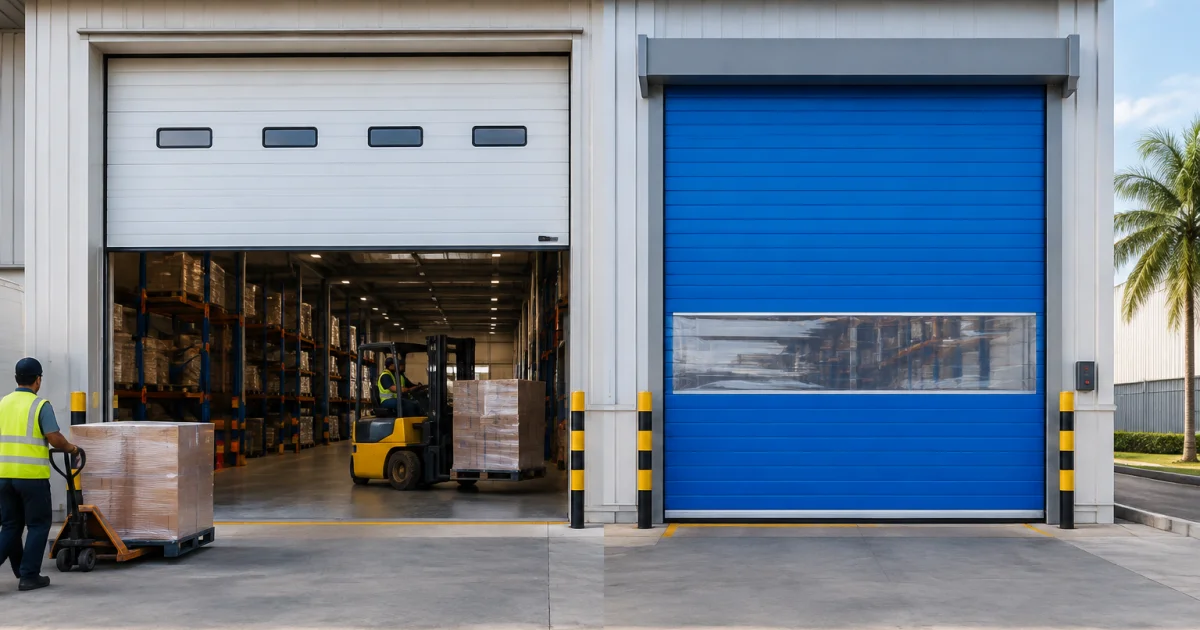
Choosing an industrial door is rarely about “the best door” and almost always about “the best door for this opening.” In factories and logistics hubs, a poor fit creates daily friction: vehicle queues, temperature leakage, noise, security gaps, and repeated maintenance resets.
This article takes a clear position: an Overhead Sectional Door is often the most balanced choice when you need a secure, insulated, space-efficient closure—but it’s not the fastest option, and it’s not always ideal in high-impact traffic zones. The right decision depends on shift patterns, forklift routes, climate separation, exposure, and how much downtime you can tolerate.
What “winning” means in an industrial door decision
Most buyers evaluate industrial doors on five outcome areas:
- Security and access control: forced-entry resistance, automation integration, dependable locking, consistent closing.
- Thermal and environmental separation: insulation, air exchange, dust/pest control, humidity management.
- Traffic flow: opening speed, cycle rate, visibility, safe movement for people and vehicles.
- Space and building constraints: headroom/side-room, sprinklers/ducting conflicts, proximity of staging and trucks.
- Total lifecycle effort: servicing frequency, adjustments, spare parts, and the cost of breakdowns.
Different door types optimize different parts of the scorecard. The goal isn’t a “best door” in isolation—it’s best fit for your dominant constraint.
Where overhead sectional doors clearly win
Sectional doors use horizontal panels that lift vertically and track along the ceiling. That geometry delivers a rigid barrier without swinging into the traffic lane, while storing overhead rather than along a wall.
1) Security and sturdiness for perimeter openings
For external openings that must be secure after hours and stable in harsh weather, sectional doors are a strong default. The rigid construction typically inspires more confidence than flexible curtain-style systems, making them common for warehouse entrances, dispatch openings (when speed is not the main constraint), and doors facing public roads.
2) Insulation and tighter sealing potential
When temperature and environmental separation matter, sectional doors can be specified with insulated panels and perimeter seals. Even when you’re not building a freezer, better sealing can reduce hot air infiltration, humidity swings, and air-conditioning load in selected zones—one reason they’re frequently shortlisted for Industrial Door Malaysia requirements that balance security with environmental control.
3) Space efficiency with a rigid barrier
Unlike swing doors, sectional doors don’t intrude into forklift paths. Unlike sliding doors, they don’t require long wall run-off to park the leaf. Where headroom allows and tracks can be routed around services, they fit well in tight loading-bay staging areas.
4) Strong all-rounder for mixed traffic patterns
Sectional doors are rarely the fastest, but they are often “fast enough” for moderate cycle rates while still offering strength and sealing. If an opening sees mixed use (pedestrians, pallet jacks, intermittent forklifts), they often provide the best middle ground.
IGT Group’s Easylift Overhead Sectional Door is an example of this category, positioned for secure vertical operation, efficient space use, and insulation-oriented configurations.
Where other industrial doors beat sectional doors (and why)
Sectional doors have clear limits. If the opening is wrong for the technology, you’ll see it quickly in queues, damage, and reactive maintenance.
1) High-throughput lanes: high-speed roll-up doors win on cycle time
In constant forklift lanes or high-frequency internal separation, opening speed and cycle rating become decisive. High-speed roll-up/rapid doors typically outperform sectional doors by reducing wait time, improving flow, and shortening exposure to heat, dust, or fumes.
Many sites get the best outcome by “layering”: a high-speed door for internal traffic separation and a sectional door where perimeter security is the priority. For frequent-cycle operations, see Easyrapid Roll Up Door for context on what’s typically specified (speed targets, safety sensors, impact recovery, service access).
2) Impact-prone openings: flexible solutions can be more forgiving
At blind corners or in areas with new operators, a rigid sectional door can suffer panel damage or track misalignment, creating downtime. Some high-speed systems are designed to tolerate minor impacts and recover faster, while PVC strip curtains can absorb small bumps in low-risk internal separations. The more chaotic the traffic, the more recoverability matters.
3) Short openings between rooms: PVC swing doors win for walk-through convenience
For short internal passages—especially where staff push trolleys or carry items—PVC swing doors reduce friction: hands-free movement, good visibility, and simple hygienic separation. They’re not security doors, but they often outperform sectional doors for internal workflow simply by eliminating waiting time.
For production rooms where visibility and easy access matter, Clearway Pvc Swing Door may be a more natural fit than automating a larger industrial opening.
4) Very limited headroom: alternatives may be easier to fit
Sectional doors need overhead travel space and track routing. If headroom is low or M&E services are dense, installation can become complex. Depending on the survey, roll-up configurations or other systems may integrate more cleanly.
Practical comparison: choose by use-case, not by product name
Use-cases often map to door types like this:
| Scenario | What usually matters most | Door type that often fits |
|---|---|---|
| External warehouse entrance or dispatch opening | Security, weather resistance, reliable closing | Overhead sectional door |
| Internal forklift lane with constant movement | Speed, cycle rating, reduced air exchange | High-speed roll-up / rapid door |
| Cold or temperature-controlled zone boundary | Sealing, fast closing, condensation management | Often a combination: fast door internally + insulated closure where needed |
| Personnel pass-through between production rooms | Hands-free access, visibility, hygiene separation | PVC swing doors |
| Low-risk separation for dust/insects, light traffic | Low cost, easy movement, quick replacement | PVC strip curtains (with realistic expectations) |
| High-value inventory area | Access control, strong barrier, stable automation | Sectional door (or other rigid/security-first solution) |
Pick the solution that best satisfies the dominant constraint. Throughput favors speed doors. Security and insulation often favor sectional doors. Hands-free movement favors swing doors. Frequent bumps favor impact-tolerant or low-consequence systems.
My opinionated decision checklist (what to ask before you buy)
Use this checklist to compare quotations and site proposals and to avoid buying a door that looks good on paper but fails in daily operations.
Traffic and operations
- How many cycles per hour during peak periods?
- Is there a forklift turning point near the opening that raises collision risk?
- Do pedestrians share the opening, and do you need visibility through the door?
Environment and separation
- Are you controlling temperature (air-conditioned zone, chilled room, or simply reducing heat/humidity ingress)?
- Are dust and insects a problem, and is the opening exposed to outdoor air?
- Do you need a tight seal or a “good enough” workflow barrier?
Building constraints
- Headroom and side-room: is there space for tracks and a clean travel path?
- Ceiling services: sprinklers, ducting, cable trays—will track routing conflict?
- Wind and weather exposure: is the opening hit by strong gusts or driven rain?
Maintenance reality (often ignored until it hurts)
- Who resets the door after minor incidents—your team or a technician?
- Do you prefer repairable rigid panels or an impact-recoverable system designed to “pop out and recover”?
- Do you have a preventative maintenance plan for critical openings to reduce peak downtime?
If two options still look similar, use a tie-breaker: choose the door that fails more gracefully in your environment.
Conclusion: sectional doors are a smart default—until speed or impact becomes the priority
For many factories and logistics facilities, an overhead sectional door is the most sensible all-round industrial closure: strong, secure, potentially well-insulated, and space-efficient. That’s where it wins.
Where it doesn’t win is just as important. High-speed doors usually perform better in high-frequency traffic lanes by improving flow and reducing exposure time. PVC swing doors often outperform for short internal passages by removing waiting entirely. And in impact-prone areas, choosing a more tolerant solution—or improving traffic design—can prevent repeated downtime.
The best results come from treating doors as part of the material-handling system: traffic routes, loading-bay process, temperature strategy, and maintenance planning working together. For industrial sites in Malaysia, a site assessment that matches door type to usage patterns and constraints is often the fastest route to the right decision.
Frequently Asked Questions
Is an overhead sectional door suitable for high-traffic forklift lanes?
Sometimes, but it depends on cycle rate and how close forklifts turn near the opening. Sectional doors can work for moderate traffic, but for constant back-and-forth movement, high-speed roll-up doors are often better because they reduce waiting time and limit how long the opening stays exposed.
When should I choose a high-speed roll-up door instead of a sectional door?
Choose a high-speed roll-up door when throughput and fast opening/closing are the main priorities—such as internal logistics lanes, busy dispatch areas, or zones where you want to reduce air exchange. It’s also a strong option if you want a door designed for frequent cycling and quicker operational recovery after minor impacts.
What is the difference between PVC swing doors and PVC strip curtains?
PVC swing doors create a defined doorway with rigid panels that swing open and close, offering clearer separation and visibility for people and trolleys. PVC strip curtains are flexible overlapping strips that allow push-through movement and basic dust/insect control, but they typically provide less structured access control and a looser seal.
How do I decide between an industrial garage door and an overhead sectional door?
In many industrial contexts, “industrial garage door” is used informally to describe sectional-style doors used in commercial facilities. The practical decision should focus on specifications: insulation needs, wind exposure, automation requirements, cycle frequency, and the quality of tracks, panels, seals, and safety features—not just the label.
Do suppliers provide high-speed door supply and installation as a complete package?
Many specialist providers do. A complete package typically includes site assessment, sizing and configuration, installation, safety device setup, testing/commissioning, and after-sales servicing. For industrial sites, it’s also worth asking about preventative maintenance options and spare-part availability to reduce downtime.
Need help selecting the right industrial door for your opening?
IGT Group helps factories, warehouses, and logistics operators match the door type to real traffic flow, security needs, and environmental separation—so you avoid costly “wrong door” decisions. From Easylift overhead sectional doors to Easyrapid high-speed roll-up doors, Clearway PVC swing doors, and professional installation, maintenance, and repair, our team can recommend a practical configuration for your site.