
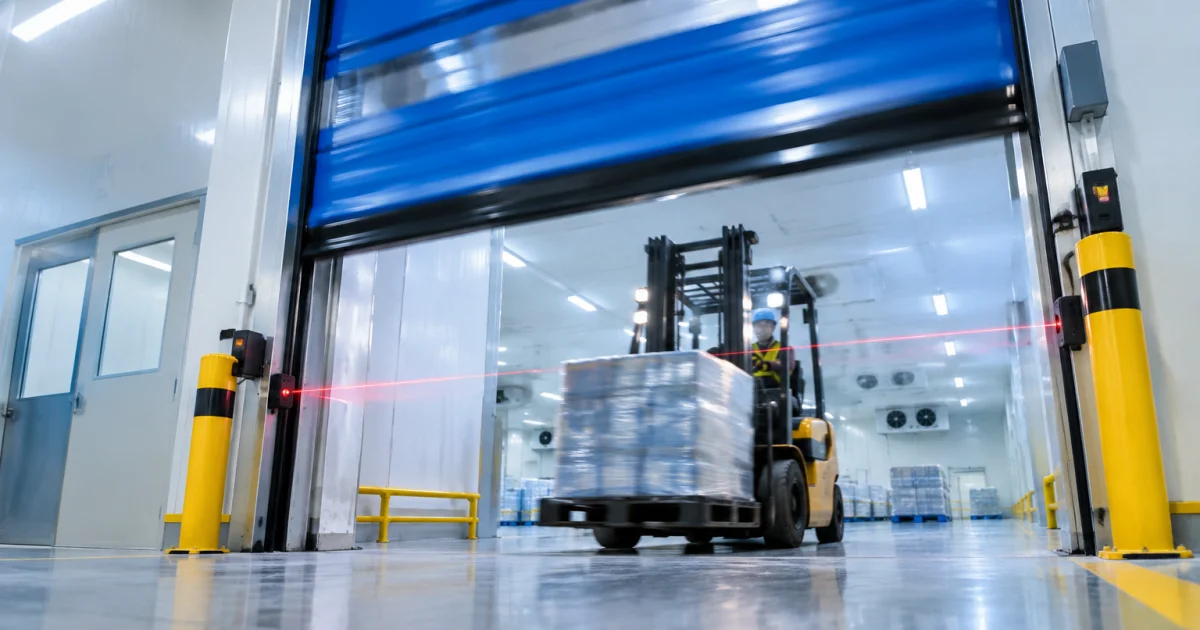
In high-traffic warehouse corridors and cold-room transitions, a door is no longer just a “door.” It acts as a safety device, an energy-control boundary, and a throughput tool that determines whether forklifts queue—or flow. In 2026, purchasing discussions around a Fast Speed Door are shifting from headline opening speed to what makes performance sustainable: smarter sensing, higher endurance, and sealing that holds up in real operations.
This article outlines what’s changing (and what suppliers should prove) when upgrading high-use access points in Malaysia—especially where temperature control, hygiene zoning, or continuous forklift traffic makes downtime expensive. You’ll also find practical examples, a procurement checklist, and guidance on pairing high-speed roll-up doors with complementary barriers (PVC swing doors or strip curtains) to meet targets without overbuilding.
Why 2026 specs are shifting: safety, uptime, and energy pressure
Warehouses and cold storage sites face the same squeeze: faster turnaround expectations, tighter margins, and greater scrutiny on safety and temperature stability. As a result, three feature priorities dominate most upgrade decisions:
- Smarter safety sensors that protect people and vehicles while reducing nuisance stops.
- Higher cycle ratings that match real traffic and reduce unplanned repairs.
- Better sealing to cut air exchange, condensation risk, and refrigeration load at thresholds.
These priorities are connected. Better sealing needs good alignment and controls; better controls depend on reliable sensing; and high-cycle endurance improves when collision events and mis-tracks are reduced. Strong projects treat the door as part of a “traffic opening system,” not a standalone product.
Trend 1: Smarter safety sensing that’s less disruptive (and more reliable)
Traditional safety setups can be overly sensitive, causing frequent stops and reopens. That reduces throughput and accelerates wear. In 2026, the expectation is better discrimination: detect what matters without turning every passage into a stop-and-go cycle.
What “smarter” looks like in day-to-day traffic
Smarter sensing is not simply adding devices. It’s using positioning, protection, and control logic so safety is maintained with fewer false triggers. Buyers increasingly ask for:
- Multiple detection layers (for example, light curtains paired with photo-eyes) to respond appropriately to pedestrians vs forklifts.
- Resistance to dust, condensation, and mist, especially at chilled/freezer approaches where fogging can occur.
- Protected mounting and cable routing to prevent routine knock-outs from pallets, forks, or washdown.
- Controller logic that reduces nuisance reversals (for example, hold/slow near an object rather than repeated full stop cycles), while still operating safely.
Practical example: In a distribution-aisle opening with near-constant forklift movement, a single low photo-eye can trigger repeatedly due to pallet overhang, shrink wrap tails, or reflections. A better setup uses protected mounting and a wider, more reliable detection field, then tunes the controller to keep the door open for a short “traffic window” during peak movement—closing quickly once the zone is clear.
Questions to ask during site survey (so you don’t buy “paper safety”)
- Where will sensors sit relative to fork height, pallet profile, and approach angles?
- When the detection zone is interrupted, will the door stop, reverse, hold-open, or reopen?
- What happens during condensation events at cold-room entrances—does sensing degrade?
- How are components protected from impact/misalignment, and how quickly can they be replaced?
Good suppliers treat these as engineering inputs, not sales objections. Fewer false triggers also reduce the temptation for operators to bypass procedures.
Trend 2: Higher cycle ratings—and more honest sizing for real traffic
Cycle duty matters because high-speed doors are usually installed at the busiest openings: dispatch lanes, internal cross-traffic corridors, chilled-to-ambient transitions, and hygiene zoning. When a door is underspecified, the pattern is predictable: more service calls, more downtime, and temporary fixes that don’t address the root cause.
What to look for beyond a brochure cycle number
Better procurement discussions focus on system durability, not only the motor claim. Ask how the full assembly supports continuous use:
- Drive system and controller: built for high-frequency operation across shifts, not just occasional peak use.
- Curtain material and edge guidance: tolerance for minor impacts without frequent mis-tracks.
- Self-reinsertion / breakaway features: fast recovery after a clip or bump to reduce callouts.
- Maintenance access: safe access to wear points without extended shutdowns.
Practical example: A cold storage facility uses a high-speed roll-up door between a -18°C freezer and a staging area. During peak picking, open/close cycles surge. If duty is too low, guide wear and bottom-bar misalignment often appear first—creating sealing gaps and increasing icing risk. A higher-duty system helps, but only when paired with correct sealing strategy and traffic discipline (see Trend 6).
How to estimate traffic realistically (a quick field method)
- Choose the busiest hour on a typical peak day.
- Count door openings for 10 minutes (manual tally, CCTV, or WMS timestamps).
- Multiply by 6 to estimate cycles per hour.
- Multiply by operating hours and compare openings to prioritise upgrades.
Share the estimate with your supplier and ask them to recommend an appropriate duty class and maintenance plan. Vague answers are a common sign the proposal is based on speed alone—speed is not endurance.
Trend 3: Better sealing to control air exchange, moisture, and temperature drift
For cold chain operators, sealing affects more than energy: it influences product risk, condensation and icing at thresholds, and comfort/safety for staff working nearby. For ambient warehouses, sealing still matters for dust control, insects, and cross-drafts into process areas.
Sealing improvements that buyers are prioritising
- Upgraded side guides and bottom seals that maintain contact despite minor floor irregularities.
- Better fit-up tolerance so performance holds even when openings aren’t perfectly square (common in older sites).
- Fewer leakage paths at the header and improved curtain-to-frame interfaces.
- Materials suited to cold and washdown where stiffness, brittleness, or warping can appear over time.
Practical example: In a chilled food-processing corridor separating raw and cooked zones, poor sealing can lead to persistent fogging and wet floors near the threshold. That raises slip risk, adds cleaning load, and can increase sensor nuisance trips as moisture accumulates.
When a high-speed door should be paired with a secondary barrier
Better sealing doesn’t always mean “one door solves everything.” Many facilities perform best by pairing a fast door with a passive secondary barrier:
- PVC strip curtains for internal openings needing visibility and constant air resistance with easy passage.
- PVC swing doors for pedestrian or pallet-jack routes requiring hands-free push-through while maintaining separation and visibility.
Secondary barriers can also reduce how often the high-speed door cycles during mixed-traffic periods, supporting cycle life and reducing wear.
Trend 4: Controls that prioritise flow—smarter activation and “right-time closing”
Door speed is only part of throughput. In busy corridors, bigger losses often come from activation and timing issues: late triggering (forklifts brake), over-triggering (door opens for non-traffic), or long close delays that leave openings open too long.
Activation methods being used more strategically
Sites are matching activation to traffic type and risk profile:
- Motion/radar activation for vehicle approaches with consistent travel paths.
- Pull-cord or push-button where deliberate control is needed (controlled zones, security points).
- Loop detectors at vehicle-only lanes to avoid responding to pedestrians outside the travel line.
- Interlocking logic for airlocks/anterooms so one door cannot open until the other is closed.
Practical example: At a cold-room anteroom, if both doors can open freely you create a direct air path and rapid moisture ingress. Interlocking keeps the barrier intact while still allowing steady movement—especially when supported by clear traffic rules and simple status indicators for operators.
Ask for commissioning, not just installation
Controls require commissioning: close-delay tuning, activation distance adjustment, and safety-response setup based on real behaviour. When evaluating quotes, confirm what commissioning is included and whether the supplier will return after a short run-in period to fine-tune. This is where “high speed doors supply and installation” becomes operational value rather than a line item.
Trend 5: Designing for maintainability—faster recovery, easier servicing, less downtime
High-cycle doors are maintenance assets. The 2026 shift is lower tolerance for long outages, so buyers are evaluating how fast a door can be restored after common disruptions: minor impacts, sensor misalignment, consumable wear, or control faults.
Features and practices that reduce downtime
- Impact tolerance and quick reset: curtains/guides designed to withstand minor clips and recover quickly.
- Modular components: swap-friendly sensors and protected cabling that simplify troubleshooting.
- Service access: safe access to key wear points without major disassembly.
- Preventative maintenance: scheduled checks of guides, bottom bar, seals, and sensing before performance drops.
Actionable tip: Add a simple routine “door health” check: look for sealing gaps, unusual noise, slower travel, and repeated reversals. Capturing these early often prevents peak-hour failures.
Why after-sales support is part of the spec
Even the right model needs responsive service and genuine spare parts. If downtime affects dispatch or temperature stability, evaluate after-sales capability alongside the door: technician availability, response process, parts lead times, and whether a preventative maintenance plan is available.
Trend 6: System thinking—combining high-speed doors with sectional doors, swing doors, and dock equipment
Many facilities are upgrading multiple access points at once. A common 2026 approach is to define each opening by its job—security, insulation, traffic separation, or loading transfer—then select the best-fit system. High-speed doors are often strongest when integrated with complementary products.
High-speed roll-up vs sectional door: how buyers are deciding
High-speed roll-up doors are typically selected for frequent internal traffic. A sectional door (overhead sectional) is often chosen where security, insulation, and weather resistance matter most—such as external openings, dispatch bays, or positions where the door stays closed longer.
Practical example: A distribution centre may use a high-speed door internally between picking and staging, while installing an insulated overhead sectional door at the perimeter for security and thermal performance. This split often outperforms forcing one door type to do every job.
If you are considering an overhead option for external bays, see the product overview for Easylift Overhead Sectional Door as a reference point for typical use cases and features to compare.
When PVC swing doors or strip curtains make more sense
Not every opening requires a powered door. For smaller internal passages—especially pedestrian-heavy or pallet-jack routes—PVC traffic doors can be a better fit:
- Clearway PVC Swing Doors enable fast, hands-free movement with high visibility.
- PVC strip curtains reduce drafts, dust, and insects while supporting constant pass-through.
These options can reduce the workload on automated doors, improving uptime and reducing service demand.
For a closer look at a common traffic-door option, visit Clearway Pvc Swing Door to understand where it fits alongside high-speed doors in a full access plan.
Loading-bay performance: doors are only part of the dock equation
At loading bays, throughput and safety also rely on levellers, shelters, and dock protection. Door sealing benefits are strongest when the dock edge is managed as well—reducing infiltration and improving transfer safety. If your upgrade touches dispatch lanes, review dock equipment and door strategy together rather than treating doors as a standalone fix.
What to specify when buying a high-speed door in Malaysia (procurement checklist)
Whether you’re searching for High Speed Door Malaysia suppliers or comparing proposals across sites, the key is turning these trends into specification language.
1) Safety and sensing
- Define the traffic mix (forklifts, pedestrians, pallet jacks) and likely approach angles.
- Specify the sensing approach (photo-eyes/light curtains/motion) and desired behaviour during obstruction.
- Confirm sensor protection and suitability for dust, moisture, and condensation.
2) Duty and cycle expectations
- Provide estimated peak and average cycles per hour.
- Ask expected wear points and recommended maintenance intervals.
- Confirm impact recovery capability and typical reset time after minor incidents.
3) Sealing and environmental separation
- Define temperature differentials and humidity conditions across the opening.
- Ask how bottom/side sealing is achieved and how it tolerates uneven floors.
- Consider airlock/interlock needs for cold rooms and hygiene zones.
4) Controls and activation
- Select activation suited to the opening (radar, loop detector, push button, pull cord).
- Confirm commissioning scope: close delay tuning, activation distance, safety logic.
- Ask about fault handling: response to sensor faults or power disturbances.
5) Serviceability and support
- Ask which spare parts are stocked and typical lead times.
- Confirm service response expectations and preventative maintenance availability.
- Ensure handover includes operating rules for staff to reduce impacts and bypassing.
Conclusion: choose the 2026 upgrade that reduces friction, not just seconds
The best 2026 high-speed door upgrades remove operational friction: near-misses, nuisance stops, avoidable maintenance, temperature swings, and bottlenecks at busy openings. Smarter sensors help the door behave correctly around people and forklifts. Higher duty ratings matter when traffic is relentless. Better sealing protects cold-chain stability and reduces moisture problems that can cascade into downtime.
For warehouses and cold storage facilities, the most cost-effective approach is often a system plan: use high-speed roll-up doors where frequency demands automation, add secondary barriers where they reduce air movement and door cycles, and match external openings with sectional or motorised doors when security and insulation dominate. If your specification reflects real traffic, real environments, and maintainability, the door stays fast after year one—not only on day one.
If you are comparing options now, it can help to review product categories and installation approach on a dedicated page such as High Speed Door Malaysia and align the final selection to the operational reality at each opening.
Frequently Asked Questions
What should I look for when comparing high speed doors supply and installation quotes?
Compare more than the door model. Ask what sensing devices are included, how commissioning/tuning will be done, what cycle duty the system is designed for, what sealing method is used, and what after-sales support and spare parts availability look like. A good quote explains the site assumptions (traffic volume, temperature difference, activation method) and includes a clear installation and handover scope.
How do I choose the right safety sensors for a high-traffic forklift opening?
Start with the traffic pattern: approach speed, lane width, and whether pedestrians share the opening. Many forklift-heavy openings perform best with a combination of presence detection (such as a light curtain or well-positioned photo-eyes) and activation sensing (radar/loop detector) that opens early enough to avoid braking. Also confirm housings and mounting are protected from impacts and that the control logic is set to reduce nuisance stops while still responding safely to obstructions.
Are high-speed roll-up doors suitable for cold storage and freezer transitions?
Yes, but they must be specified for the temperature difference and moisture conditions at the opening. Prioritise fast closing, reliable sealing, and a control strategy that limits unnecessary open time. In many cold-chain layouts, adding an anteroom interlock or pairing the door with a secondary barrier (like strip curtains) can further reduce air exchange and condensation risk.
When should I use an overhead sectional door instead of a high-speed door?
Choose an overhead sectional door when the opening is primarily external or needs strong security, weather resistance, and insulation while staying closed for longer periods. High-speed doors are typically better for frequent internal traffic points where rapid cycling and workflow flow are the main priorities. Many facilities use both: sectional doors at the perimeter and high-speed doors inside for high-frequency separation.
Can PVC swing doors or PVC strip curtains replace a high-speed door?
They can in the right scenario. PVC swing doors work well for pedestrian and pallet-jack routes where hands-free push-through and visibility are important. PVC strip curtains are useful for reducing drafts, dust, and insects while allowing constant pass-through. However, for very high-frequency forklift traffic, strict temperature control, or controlled-access openings, an automated high-speed door may still be the better primary solution—sometimes with PVC barriers used as a secondary layer.
Plan a high-speed door upgrade that stays fast after installation
IGT Group helps warehouses and cold storage facilities specify, supply, install, and support industrial access systems built for real traffic—high-speed roll-up doors, PVC barriers, sectional doors, and loading-bay solutions. If you’re upgrading a critical opening, we can review your traffic flow, safety sensing needs, and sealing requirements to recommend a practical setup and a maintenance plan that reduces downtime.