
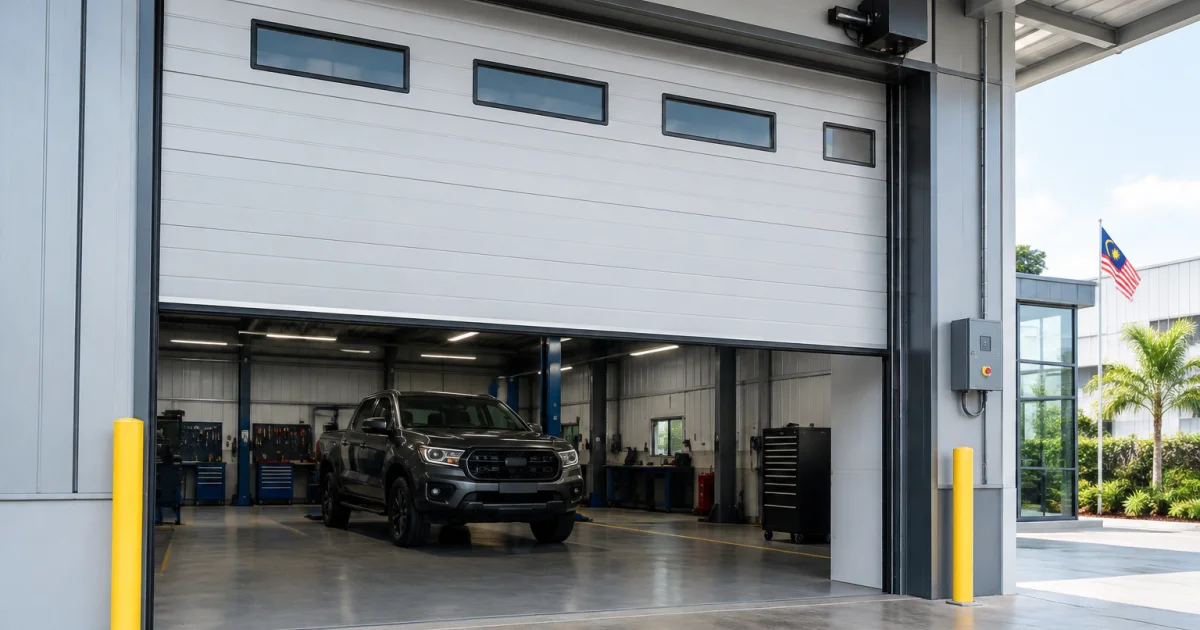
In commercial sites, a garage door is more than a “big shutter.” It’s a moving wall that affects heat gain, staff safety, site security, and whether daily operations run smoothly. In Malaysia’s heat, heavy rain, and occasional strong winds, getting the specification right matters—especially for automotive workshops, service centres, retail receiving bays, and facilities with early/late shifts.
This guide offers a practical way to shortlist a Garage Door Malaysia solution for commercial use. It prioritises three decision pillars that should come before aesthetics: insulation, wind load, and security. You’ll also find a supplier question checklist to make quotations comparable, plus guidance on when a different door type (such as a high-speed roll-up door) is the better operational fit.
Start with the job: what does the opening need to do every day?
Before comparing panel thicknesses or motor brands, define what success looks like for your site. Commercial requirements are usually driven by throughput, separation, and risk—not appearance.
- Traffic pattern: cycles per day; vehicles vs forklifts vs pedestrians.
- Operating hours: early starts, late closures, or multi-shift activity.
- Environmental separation: heat, rain splash, dust, fumes, insects, noise.
- Security risk: back lane exposure, standalone workshop, shared corridors.
- Space constraints: headroom/ceiling clearance for hoists, ducting, sprinklers, signage, racking.
If you can summarise these needs in one paragraph, you’ll shortlist faster and avoid paying for features that don’t move operational KPIs. A common commercial mistake is choosing what “looks industrial” without matching the door design to cycle rate, sealing needs, and security procedures.
Insulation: when it matters (and when it’s just a nice-to-have)
Insulation isn’t only for cold rooms. For many commercial sites, insulated sectional panels can improve comfort, reduce temperature swings, and help with noise and condensation control. However, “insulated” varies widely in real performance, and insulation is often limited by air leakage rather than the panel core.
Where insulated sectional doors usually pay off
- Air-conditioned reception/front-of-house adjacency: better insulation and sealing reduces heat gain when the door is closed.
- Sensitive stock areas: stabilising humidity/temperature swings can protect packaging, electronics, and certain goods.
- Noise management: workshops near offices/clinics/residential boundaries can benefit from improved acoustic dampening.
What to check beyond “panel thickness”
- Perimeter seals: bottom, side, and top seals—these often determine real-world performance.
- Panel joint design: how panels meet and stay aligned over time to resist air gaps.
- Thermal bridging points: hardware mounts and frame interfaces; better construction reduces heat transfer paths.
If your opening cycles constantly, insulation on a slower-moving door can deliver less value than fast closure. In high-frequency lanes, a high-speed door may reduce air exchange more effectively by minimising open time. If you’re considering that route, review High Speed Door Malaysia to see where fast operation improves separation.
Wind load: the most ignored spec that causes the biggest headaches
Wind load is often treated as an engineering footnote, but the consequences show up operationally: door rattle, misalignment, water ingress, accelerated wear on rollers/tracks, and difficult operation after storms. Commercial sites also tend to have larger openings and more exposure (open carparks, corner lots, corridors between buildings), which amplifies the issue.
If your site is even moderately exposed, treat wind load as a primary requirement. It is typically cheaper to specify correctly upfront than to repeatedly “adjust” a door after windy days.
Practical site factors to tell your supplier
- Door size: width and height (larger doors experience greater force).
- Orientation and exposure: faces open areas, highways, or coastal wind.
- Building geometry: corner locations and long passages can accelerate gusts.
- Usage during wind: frequently partially open, or held open for long periods.
What wind-ready construction typically includes
Wind-capable configurations usually depend on stronger tracks, reinforced panels, robust brackets, and correct anchoring to the building structure. Wind performance is a system outcome: components, mounting method, and substrate (concrete, steel, masonry) need to work together. Ask what reinforcement is proposed and what anchoring assumptions are being used.
If you’re comparing an industrial garage door quotation across suppliers, require wind-related assumptions in writing. A quote that’s silent on wind considerations may not be like-for-like.
Security: think in layers (door, operator, access, and behaviour)
Commercial security works best as a layered system. A stronger panel helps, but outcomes are often determined by weak points: side gaps, emergency release handling, access-control habits, and how the operator behaves during power interruptions.
Door hardware and physical resistance
- Panel and track rigidity: forced-entry resistance comes from overall stiffness, not only panel material.
- Locking approach: manual locking vs motor/operator-integrated locking features.
- Bottom bar and side sealing: tighter fit reduces pry points and improves weather sealing.
Motorised operation: security and safety go together
A Motorised Garage Door can improve security by reducing human error (forgotten locks, doors left ajar) and enabling controlled access. Specify motorisation with safety and operational discipline in mind:
- Controlled access: remotes, wall controls, or integration with site procedures.
- Safety features: obstruction detection and safe operation in staff/vehicle areas.
- Manual override management: practical during power issues while protected from misuse.
For many commercial sites, the most effective “security upgrade” is motorisation plus clear operating rules: who holds remotes, how access is logged, and how end-of-day closure is verified.
Sectional door vs other door types: choose based on operation, not habit
Many buyers start with “garage door” but the real need is “large access door.” The right category depends on cycle rate, separation requirements, and available headroom.
When an overhead sectional door is a strong fit
- Back-of-house openings where the door stays closed for long periods and opens for scheduled deliveries.
- Automotive workshops needing secure closure after hours with overhead travel that preserves usable floor space.
- Sites prioritising insulation when closed, compared with thinner sheet-based options.
If this matches your use case, see Easylift Overhead Sectional Door for typical configuration and options.
When a high-speed roll-up door can outperform a sectional door
When traffic is constant, open-time becomes the main driver of energy loss and contamination risk. High-speed roll-up doors are built to open and close quickly, making them suitable for warehouses, controlled environments, and busy logistics lanes. Compare the operational advantages at Easyrapid Roll Up Door.
Don’t ignore internal separation doors for workflow and hygiene
Improving internal separation can be as valuable as upgrading the main entrance. If your workshop connects to parts storage, receiving, or a cleaner zone, internal barriers can reduce dust transfer, manage airflow, and improve safety visibility. Options include Clearway Pvc Swing Door for frequent pedestrian/hand-trolley traffic, or PVC strip curtains where a full door is unnecessary. These complement the main door rather than replace it.
A practical specification checklist to request before you commit
To compare proposals fairly, ask every supplier to respond to the same questions. This reduces “apples vs oranges” quotations where a lower price simply omits essential components or makes unspoken assumptions.
| Category | What to request (commercial essentials) | Why it matters |
|---|---|---|
| Opening survey | Confirmed clear opening size; side room; headroom; backroom; structural substrate | Ensures tracks/operator fit and anchoring is appropriate |
| Insulation & sealing | Panel construction; perimeter seal details; bottom seal type | Controls heat, rain splash, dust and noise when closed |
| Wind considerations | Track thickness/reinforcement; panel reinforcement; anchoring method assumptions | Improves reliability and reduces storm-related misalignment |
| Security | Locking approach; emergency release handling; access control method | Reduces forced-entry risk and “left-open” incidents |
| Operator (motor) | Duty rating suited to expected cycles; safety features; control options | Prevents premature wear and improves day-to-day usability |
| Maintenance | Recommended service interval; spare parts availability; response expectations | Limits downtime and extends door lifespan |
If a supplier can’t answer these clearly in writing, you may be taking on avoidable risk. Commercial doors are long-lived assets; documentation matters for consistency, handover, and future maintenance.
Conclusion: buy the performance you need, then support it with maintenance
Choosing a commercial garage door in Malaysia is about matching the door system to real site conditions. If the opening must hold back heat and noise, prioritise insulation and sealing quality. If exposure is a factor, treat wind load as a true requirement. And if the door is part of your security perimeter, think in layers: door structure, motorised operation, access control, and staff habits.
The best result is rarely the “most heavy-duty” option. It’s the most appropriate specification, installed correctly, then supported with preventative maintenance—so operations face fewer stoppages, fewer adjustments, and fewer surprises after storms or long weekends.
Frequently Asked Questions
Is an insulated sectional door worth it for a commercial workshop in Malaysia?
Often, yes—if the door stays closed for meaningful periods and you benefit from reduced heat gain, better comfort, or less noise. The bigger value usually comes from good perimeter sealing (bottom, sides, top) and solid panel joints, not just “thicker panels.” If your opening cycles very frequently, a fast-closing door type may reduce air exchange more effectively than insulation alone.
What should I ask about wind load for a commercial garage door?
Share the door size, whether the opening is exposed to open carparks/highways/coastal wind, and whether the door is left partially open during operation. Ask the supplier to specify what reinforcement is included (tracks, brackets, panel reinforcement) and what anchoring assumptions they are using based on your wall/steel structure.
Does a Motorised Garage Door improve security?
It can, because controlled operation reduces human error (forgetting to lock or leaving the door ajar) and supports consistent access procedures. Security still depends on the full system: panel/track rigidity, how the emergency release is managed, who controls remotes, and whether staff follow end-of-day closure checks.
Sectional door vs high-speed roll-up door: which is better for commercial use?
A sectional door is a strong fit when you want secure closure, good insulation potential, and the door stays closed between scheduled openings. A high-speed roll-up door is usually better when traffic is constant and minimizing open time is the priority for temperature control, dust reduction, or workflow efficiency. Many facilities use both types in different parts of the site.
What does a supplier typically include in high speed doors supply and installation?
Typically it covers a site survey, door and operator selection, installation of frames/tracks/curtain and controls, safety devices, testing and commissioning, and basic user handover. For commercial reliability, also ask about preventative maintenance, spare parts availability, and support for repairs to reduce downtime.
Plan a commercial garage door spec that fits your site
If you’re comparing options for insulation, wind resistance, and security, IGT Group can help you translate site conditions into a clear, quotable specification—then support it with professional installation, maintenance, and repair.
Speak with IGT Group about Easylift Overhead Sectional Doors and Easygarage Motorised Doors, and whether a high-speed roll-up door or internal traffic doors (like Clearway PVC Swing Door) would improve your workflow.